
Venger came back to the Red Room to talk about Cha’alt: Chartreuse Shadows, the indie role-playing game community, game mastering sleazy scenarios, the wokification of the RPG industry, and other subjects.

As previously announced on the blog, the Red Room now is also on YouTube. It’s still a small channel, so we need people to subscribe and share. For now we’re aiming at 100 subscribers. Thanks!

We’re ending the year with a new project: the “Welcome to the Red Room” interviews are moving from the blog to a YouTube channel, which will also feature reviews, rants and other content. Our first guest is Gavriel Quiroga, an independent role-playing game designer from Argentina. Helder Araújo, a Portuguese game designer and RPG reviewer, will be next. Check it out and, if you like it, please share and subscribe!

This has been a busy year here at the Red Room, with six books published by Postmortem Studios – Orpheum Lofts, The Memorial, The Sisters of the Seven Sins, Welcome to St. Cloud, Postcards from Avalidad and As Above, So Below -, a few interviews to independent role-playing game designers (Brian Shutter, Gavriel Quiroga, Liam Thompson, Venger Satanis, James ‘Grim’ Desborough and Chris Miller) as well as some other assorted articles, including the one about Giallo in Alarms and Journeys magazine issue 10. And next year may be even busier! Right now I have four new books already written and waiting for layout: the upcoming Postcards Companion an alternative setting location for Postcards from Avalidad and two Double Feature horror scenarios.
The Double Features are intended to emulate the Grindhouse phenomenon of the 1970s in a role-playing framework. There are now four of those short scenarios, prepared to be paired up in two volumes:
Double Feature Vol. 1

Sexual Holocaust: The fictional town of Hammettville, New York, is shaken by a series of gruesome and mysterious murders. The victim are all members of a S&M private club.
Brides of the Vampire: An anthology of plot hooks, set in different time periods, introduced along one character’s story, an old Eastern European vampire.
Double Feature Vol. 2

The Devil’s Country: A story within a story scenario about a movie cast and crew about to shoot a spaghetti western. Players start out as movie industry people, later slipping into their film characters in a western town situated outside our own reality.
Resort of the Dead: A George Romero/ J. G. Ballard crossover about a Zombie Apocalypse set in a formerly luxurious – but now decaying – summer resort in Portugal, during the 1980s.
Cards on the Table (working title): This is a mini-setting for Postcards from Avalidad. It adds the city of Lisbon, Portugal’s capital, to the Avalidad game world. Lisbon of the near-future is a new entry in the infamous list of gambling and vice cities of the world, such as Las Vegas, Atlantic City, Macao, Monaco and Singapore. There are several tie-ins to the original storyline through factions in the core book and plot hooks which require the characters to travel to the Iberian city. There’s also enough information to make Lisbon an alternative location for an Avalidad on-going plot.

Then there’s Nouveaupunk: Chronicles of the Belle Époque, the second campaign setting for James ‘Grim’ Desborough’s retroclone role-playing game *Punk. This one is still unfinished, but it will probably by completed early next year. And what is it about? Well, it takes place in the time period known as Belle Époque, dated between the early 1870s and 1914, at the beginning of World War I. It is neither the right time nor the right mood for Steampunk or Dieselpunk, but it is the era of Art Nouveau, an international style of art and architecture which had particular influence in the decorative arts. As it also uses the *Punk system, we called it Nouveaupunk.

This is where Umberto Eco’s Simone Simonini crosses paths with Jacques Tardi’s Adèle Blanc-Sec, Edgar Allan Poe’s Chevalier Auguste Dupin and Maurice Leblanc’s Arsène Lupin, amidst anarchist bombings, the echoes of the Dreyfus affair, the catastrophic side effects of secrets societies conspiring in the shadows and the mysterious results of experiences conducted by mad geniuses. Not quite pulp, not quite historical… but Nouveaupunk. Among the main inspirations for Chronicles of the Belle Époque there’s The Extraordinary Adventures of Adèle Blanc-Sec, a series of mildly Lovecraftian French graphic novels of the 1970s, by Jacques Tardi (also the 2010 movie adaptation by Luc Besson), Umberto Eco’s The Prague Cemetery (2010) and Edgar Allan Poe’s short stories The Murders in the Rue Morgue, The Mystery of Marie Rogêt and The Purloined Letter, featuring gentleman detective Auguste Dupin.
And there are still other plans… After finishing Chronicles of the Belle Époque I’ll move to an Atompunk setting, partly inspired by Grim Jim’s wonderfully insane ’45 – Psychobilly Retropocalypse. Already on the works is a dark, low-fantasy, high-debauchery campaign setting co-written by myself and Sílvia Clemente. Other partnerships may happen in the future, but that obviously relies on other people’s availability so I can’t add much about it. I’ve been thinking about a few more projects, but it’s too early to mention them.

A few days ago I was interviewed by DM Bluddworth for his YouTube Channel Unscripted & Unchained RPG Review. We talked about my background as a role-playing gamer and my recent experience of publishing my own scenarios through Postmortem Studios. You can check out the interview here:
https://www.youtube.com/watch?v=SgoX8n_4hKI&t=698s

Red Room: Your “cancelling” (most likely in the plural form) is almost legendary in the role-playing scene, but we still must address it and it seems to be the proper way to begin the interview. When, how and why did it all start?
James Desborough: It’s a hard thing to pin down exactly. I suppose my first hint was some time after the release of Hentacle* where a handful of headbangers started in on me on RPGnet. They called this (humorous, if pornographic) card game – amongst other things – ‘fetishised child rape’. I used some of those comments as advertising blurb, but it was demanded I take them down.
The weird part is that by modern standards I did almost everything right. I gave plenty of disclaimers and warnings, the artist was Asian, and a woman, and it was – obviously – sex positive.
That cancelling didn’t really stick, at least not at that point, though resistance to it was worn down over time.
The big issue was my article ‘In Defence of Rape’, which I wrote after the fuss about the ‘sexual threat’ in the Lara Croft reboot trailer. It was, of course, actually a defence of free speech and the right of creative people to use anything – even sexual violence – in their stories.
Nobody, it seems, read past the title and I was shocked, and am still shocked, by the extent to which the industry rolls over for these loonies.
* Hentacle was published in 2004
“The big issue was my article ‘In Defence of Rape’, which I wrote after the fuss about the ‘sexual threat’ in the Lara Croft reboot trailer. It was, of course, actually a defence of free speech and the right of creative people to use anything – even sexual violence – in their stories.”
RR: Was there a moment when you felt you could still surrender to the mob and keep working freely?
JD: No apology, however grovelling, would have been good enough. Nor could I have lived with myself if I made the performative apology and said the magic words they wanted. I couldn’t have lived with myself.
RR: What about self-publishing, did that arise from the need to get your work out there somehow?
JD: Freelancing is hard to get at the best of times, and I was typecast as a comedy writer. It arose out of necessity after I lost my job during the .com crash and couldn’t find any other work for 18 months. So it was a combination of things.
Also I bump up against other people and am anti-authoritarian in my bones.
RR: You frequently dare to touch the subject of men’s rights, which is probably not the best way to make friends at the moment… Why do you find it so important to talk about it: your own personal experience compels you to do it, or you believe you should speak out on behalf of those who can’t (or won’t) voice their own opinion?
JD: I wouldn’t say men’s rights. While I’ve appeared on shows with men’s rights activists and to talk about men’s issues I feel that the modern men’s rights movement has courted the right too much and is making many of the same mistakes as today’s ‘revenge’ feminism.

RR: What would you rather call it, then?
JD: No doubt there are issues around a deficit in men’s rights. Things like the draft, like circumcision, like legal, or at least unpunished and socially licensed, discrimination against men, like the Duluth model, like the woeful lack of support for failing men and boys. Still, I am an egalitarian, and that’s what I would call it. I don’t want to lose sight of the greater context. What we’re supposed to be striving for is equality, for everyone, before the law. My focus is upon men’s issues, solely because they have gone unaddressed for so long, and there is such resistance to considering them.
My mental health issues obviously lead me to talk about the high rate of male suicide, otherwise I think – as an egalitarian – we should address the issues where men are trodden down as much as we do those that affect women. Few people do talk about it, and they’re often cranks. I’m at least articulate and left-wing, might reach more people.
RR: You do talk about politics and social issues often, and you’re particularly eloquent about it, much more so than a great deal of YouTubers, certainly more than most other role-players. Did you have formal education or are you an autodidact?
JD: A bit of both. I dropped out of art-school but kept learning by myself. I do have a reasonably high formal education in history, politics and art however, as well as a big interest in these topics. I find I often know more about these subjects than formal graduates. I think the only thing I missed out on was the social side of university. My family needed me at the time, so no regrets – just wistfulness.
RR: Now for a sensitive subject, obviously connected to the previous questions. You have frequently talked about your suicide attempt, so I feel there’s no problem in bringing that up. What brought you to that point?
JD: There have been multiple attempts. The most public one was related to feeling utterly cut adrift during the Gamergate controversy. I was absolutely horrified about the way in which so many people I had previously respected did no independent research, didn’t trust me – their colleague and friend – and instead went with a false narrative, blindly and obediently.
It wasn’t Gamergate itself, but the ground shifting under me and releasing people who had done the right thing so often in the past had changed too much to keep doing so.
RR: Something I find interesting is that you do not give up on explaining about Socialism, Marxism and Communism to the American audience. You still hope you’ll get the message through about differences in those concepts?
JD: I’m fighting against 70 years of propaganda, so I don’t think I can make much of a dent. I just can’t let it lie! I would say my highest value is truth, I just can’t let people lie or be wrong when I know that’s what is happening.
“I was absolutely horrified about the way in which so many people I had previously respected did no independent research, didn’t trust me – their colleague and friend – and instead went with a false narrative, blindly and obediently.”
RR: Don’t you get tired of debating – not just this – but several other things over and over on social media? As you know I follow you in several networking sites and I sometimes get tired of just glancing over all the drama!
JD: I do, but it’s such a core value I can’t leave it. It feels like a hopeless, Sisyphean task, but it’s in my nature.
RR: Is there something nasty you haven’t been accused of on social media yet?
JD: Murder? Maybe?
RR: Yeah, it’s not too late for that, though… I will not mention again that one blog article whose title keeps coming up out of context but, other than that, which was the worst controversy you got caught up on?
JD: Possibly the one time I genuinely did something wrong and referred to a transperson as ‘it’. In my defence they were a horrible person who soon after got accused of sexual misconduct, were being a dick, didn’t have pronouns in their bio and was listed as both male and female online. Also, I apologised. Still, that got people in a tizzy.
RR: And since that came up, you recently got involved in all the drama surrounding TSR3, partly taking their side, as you felt some issues should have been brought up against them, other than the fake transphobia outrage. Have those other topics been already addressed?
JD: I didn’t take their side so much as the side of the truth, my core value. I was disgusted that they were being hung drawn and quartered over a lie, while points of genuine concern were left unaddressed. They mostly still haven’t been.

RR: Safety tools are a frequent subject of yours and you find their use, as most people probably know, disparaging. In what ways has that trend damaged the hobby?
JD: They’ve created the idea that games could ever be unsafe, for one. They’ve created a big divide in camps of players and have hobbled the capacity to properly do horror games, to surprise or shock players or to take risks with storylines.
RR: In Actual Fucking Monsters Companion you proposed something called the M-Card (M for Mature) as an alternative to X-Cards and such. Do you think something like that is viable?
JD: It’s slightly tongue-in cheek, a simple reversal. It seems easier to me to label your game as unsuitable for those of a particular disposition, rather than to negotiate your way through a series of almost random, catastrophised preferences from 4-6 other people.
The people who demand safety tools, X-cards etc. seem – to me – to be rather surface level thinkers. They don’t reason through the impact of their demands and requirements and the negative effect they can have on stories and drama, on plot, how disrespectful they are to the other players and the Games Master. For better or worse I am cursed with a fretful mind that almost cannot help but consider these issues.
I look at the massively negative impact these things have had already, and how they simply do not work. From allowing for the social lynching of players and Games Masters, to not preventing problems as they have with streamed games. The whole effort seems pointless and worse than useless, an empty gesture of performative conformity and fear.
Better then, as I say, to advertise that the game you are running is ‘not for you’. Then, at least in theory, you don’t have to worry.
“The people who demand safety tools, X-cards etc. seem – to me – to be rather surface level thinkers. They don’t reason through the impact of their demands and requirements and the negative effect they can have on stories and drama, on plot, how disrespectful they are to the other players and the Games Master.“
RR: I’ve decided to translate Orpheum Lofts after a few online discussions about Monte Cook’s Consent in Gaming. It made me want to put something “unsafe” out there so, in my case, the safety tools had the opposite effect. Do you feel there’s enough of a struggle against their use from the community?
JD: There is in the rank and file, there isn’t from conventions, stores and publishers.
RR: Do you think there will be a winner to the role-playing “culture wars”, or are we all doomed to lose?
JD: We all lose. Woke people are creating insufferable and insipid games and are turning crowdfunding into confession. They’ve also made games that tackle ‘progressive’ topics from a non-propagandist stance hard to publish. Equally edgy content, the interesting stuff frankly, has a lot to overcome.
“Woke people are creating insufferable and insipid games and are turning crowdfunding into confession. They’ve also made games that tackle ‘progressive’ topics from a non-propagandist stance hard to publish.”
RR: That’s an interesting point, the propagandist tone of woke game designers. The ones on the “wrong side of History” seem to have avoided propaganda in their gaming contents, haven’t they?
JD: Yes. There is a somewhat valid argument that you cannot help but influence your writing and games from your viewpoint, but the unwoke (the slept?) manage to avoid propagandising.
You’ll find common threads in my work, anti-authoritarianism, dangerous ideas, the importance of sexuality, contrarianism, second and third-order effects of SF and fantasy elements, the idea of affecting the world around you. You’ll also find shades of my personal philosophies and personal outlooks, but also things that I hate and find appalling. Their presence doesn’t mean I advocate for them, any more than writing a villain means I endorse their atrocities. It’s a bizarre way to interpret fiction, to see everything as a deep probing insight into the mentality of the creator. Some aspects of the argument are valid, but they take it too far, into the realm of parody.
Even the games that avoid propagandising now tend to include all sorts of disclaimers, and telling all sorts of people that their game is ‘not for them’. For me that’s a tell, tracing back to the disclaimers that used to be de rigeur for games during and after the Satanic Panic, underlining that the games are not real, and that you shouldn’t do anything based on what was in them.
Absurd, of course, just like all the other panics.
Speaking for myself, an alt-right gamer’s money spends as well as anyone else’s, and if they want to pay for a Left-Anarchist game designer’s lifestyle, I find that oddly fitting – and quite funny.

RR: Tell us about your most important references and influences as a writer, of both fiction and role playing games.
JD: I devour pop culture, so it’s hard to pin down anything super specific. I would say, however, that my major influences stem from the paperback Science Fiction of the 60s, 70s and 80s. When 50,000 words was good enough for a novel, short stories were valid and people played around with ideas more. Harlan Ellison’s Dangerous Visions still excite and challenge, even today.
“You’ll find common threads in my work, anti-authoritarianism, dangerous ideas, the importance of sexuality, contrarianism, second and third-order effects of SF and fantasy elements, the idea of affecting the world around you.”
To drop a few names… Ted ‘Theodore’ Sturgeon, Bill S Burroughs (esquire), Phillip K Dick, Silverberg, Poul Anderson, Phillip Jose Farmer, Bloch, Aldiss, Niven, Pournelle and a bunch more. Fantasy is not so much my bag, save the classics that made the genre. Horror-wise my taste is more 80s, Barker, Herbert, Hutson – not so much King, much as I respect his cocaine-fuelled work ethic.
A lot of more modern fiction leaves me cold, but John Courtney Grimwood, China Mieville, Joe Abercrombie, Richard Morgan, Max Barry, Stephenson, Peter F Hamilton. People who experiment and play around with ideas the way the New Wave did.
Comics are a big influence. Moore (obviously), Mills, Ellis, Gaiman.
Art too, oddly perhaps. Tim White and Jim Burns stand out in particular.
RR: You published a few works of fiction, but much less than role-playing content. Why was that?
IJD: It’s a lot more work for a lot less reward, and agents and houses aren’t interested in my kind of writing. Plus I can’t stick to a single genre and prefer short stories. Much like my Youtube channel, I do it wrong.
RR: I think I remember you mentioning you once wanted to be an artist. What went wrong (or right)?
JD: I did one year of art college (Salisbury), which was meant primarily to be a prep time to get a portfolio together to get into a degree course. The teachers were awful. I was interested in illustration, anime, comics, science-fiction and fantasy. They were interested in fine art. Once again, I simply didn’t fit what was wanted.
I attended interviews around various universities, but the interviewers were obviously hostile to what I wanted to do. There was one course that was appealing, but it was in Salford and looking at the area around the university I didn’t much fancy it. My parents had divorced a year or two before and I was needed at home. Don’t regret it. Much.

RR: How hard (pun intended) is game mastering porn stars for Tabletopless games?
JD: It’s tricky in some ways. I have to turn away when the sexy stuff comes to the fore or I’ll be too distracted to run the game. We have to balance sexytime stuff, performance and our own preference for presenting a more realistic game (in other ways) than something like Critical Role. It helps that everyone’s into the game and the story as well though, and we allow viewers to buy in and shift events. So it keeps me on my toes.
RR: How did that start? Has anything like that ever been done before?
JD: Anna and Richard had tried before with a different group and GM, but it didn’t really work out. There was ‘D&D with Pornstars’ with Zak Smith and Satine Phoenix amongst others, but they didn’t combine the two in the way we do. I think we’re the first to really make it work in terms of a combined experience, and others are coming up in our wake.
RR: You do it mostly for the money, am I correct?
JD: Hah! It’s nice to have a regular paycheque for a day or two’s work a week, and the knock on sales, and it pays better for the time spent than my regular sales, but I’m in it to get some gaming done and to have fun.
RR: If I’m not mistaken, these are the only streaming games you are currently game mastering. Did you run others before, with fully clothed players?
JD: I’ve not been a huge fan of online play before, people treat it with less commitment than face-to-face sessions. However I did run a full Dragon Warriors campaign online during lockdown, and have run odd sessions here and there.

RR: Wightchester has been in the works for some time. When do you expect to release it?
JD: Early next year, with a Kickstarter starting in August to cover additional costs and the time already spent writing. It’s taking so long because other projects keep popping up and the time taken with Tabletopless. Once I’m caught up with already submitted projects I’m putting 100% focus on Wightchester and not taking anything else on until it’s done.
RR: Now, tell us a bit about the game setting.
JD: It’s a walled city in the South of England, during the Early Modern period (1667). It’s not long after the Civil War and the Restoration, so it’s interesting times even before the dead rise and devour the living. The undead are beaten back, but the most afflicted city is walled in, filled with the dead, and used as a prison in the vague hope that prisoners will – eventually – clear out the dead.
“Once I’m caught up with already submitted projects I’m putting 100% focus on Wightchester and not taking anything else on until it’s done.”
RR: And since settings were mentioned, most of your games don’t have very detailed game worlds. Why is that?
JD: I think, as a designer, my job is to provide a context in which people make their own stories. Not to try and impose my story and particulars upon people. Too much canon becomes stifling. It’s not like writing a novel or a hyperreal imaginary atlas. I prefer to provide the tools than the finished product.
RR: When did you get into role-playing and how did you find out about the hobby?
JD: It depends, really, what you mean by ‘roleplaying’. I started with Fighting Fantasy gamebooks, which means I would have been seven or eight. Myself and a friend would play them together, with me reading the book and them making the choices. In 1984 (I was 9) Fighting Fantasy – The Introductory Role-Playing Game came out, and that was my first ‘true’ RPG encounter. Reading about other games in that led me to a model shop in Basingstoke, and thence to MERP.
RR: Fighting Fantasy was also what got me into the hobby, though I think they were only translated to Portuguese in the late 80s… Which role-playing games did you enjoy most and which influenced you as a game designer?
JD: Games that I enjoy fulfil both criteria, so… WHFRP, Dragon Warriors, SLA Industries, Cyberpunk 2013, Cyberpunk 2020, Mekton, Starblazer Adventures, FUDGE, Old World of Darkness (especially Vampire and Mage), Traveller TNE, Twilight 2000, Blood!, Legend of the Five Rings, Feng Shui, Wasted West… lots.
RR: When did you publish your first commercial role-playing content and which was it?
JD: If you count more fanzine type stuff, 1992 or so, at Gamesfair I think. Published by someone else, The Munchkin’s Guide to Powergaming in 2000. Published by myself, Cloak of Steel in 2004.

RR: Interesting, I remember Munchkin’s Guide to Powergaming but I had no idea it was your work. Do you have a favourite “child” among your games?
JD: Whichever thing I’m working on at the time. Perhaps Blood!, perhaps AFM, perhaps The Little Grey Book.
RR: For what companies did you work before publishing your own material?
JD: Mongoose Publishing, Steve Jackson Games, Nightfall Games, Cubicle 7 Entertainment, Wizards of the Coast and numerous smaller companies.
RR: Do you have a favourite genre in RPGs, both as a gamer and a game designer?
JD: Horror and science-fiction.
FOR MORE INFORMATION ABOUT JAMES DESBOROUGH AND HIS WORK, VISIT POSTMORTEM STUDIOS’ BLOG AND GRIM’S YOUTUBE CHANNEL. WIGHTCHESTER: PRISON CITY OF THE DAMNED IS ON CROWDFUNDING AT INDIEGOGO

Red Room: NEUROCITY is dark and partly Kultish. Is this what we should expect from Warpland?
Gavriel Quiroga: I aimed at a Paranoia/ Kult hybrid setting for NEUROCITY, but Warpland is a different animal, though. I think you will enjoy it. I made a huge effort for that world to make sense!
RR: Is it a science fantasy setting?
GQ: I guess it is a science fantasy and sword & sorcery mash up. My friends say it is He-Man on a bad acid trip in the middle of Patagonia.
RR: You are from Argentina, right?
GQ: Yes. I was born here but most of my life I have been travelling in Asia.
“I guess it is a science fantasy and sword & sorcery mash up. My friends say it is He-Man on a bad acid trip in the middle of Patagonia.”
RR: Is there a role-playing scene over there? I know there are lots of people working in RPGs in Brazil, but I know nothing about what’s going on in other South American countries.
GQ: The scene here is big, but it is dull and lacks courage. Most are just content with playing official mainstream RPG products. Brazil has the edge. With Diogo Nogueira as the spearhead. There is zero interest for my work in my own country!
RR: For most people the hobby is still Dungeons & Dragons and then all the rest, isn’t it?
GQ: Is it? I don’t know. I feel so alienated from those products that they feel from another dimension. Everyone I know is into the OSR independent scene. I love it.
RR: When was Warpland officially released for non-backers?
GQ: In the middle of June, but people are starting to play it only now. The setting is a bit demanding.

RR: So this is the right time to target new customers, is that so?
GQ: Yes. I’m growing awareness beyond backers, before moving to my next project, Ascet, a card game where you interpret an ascetic monk that seeks enlightenment, while demons try to lure him with temptations. Pre-launch Kickstarter will start in less than ten days.
RR: Have you developed any other games besides NEUROCITY and Warpland?
GQ: No! I have lost friends and fell into a profound vortex of chaos and depression because of these works. They are not products. I really have something to say. Every time I do this I need to bleed myself before I am finished. It is a nightmare trip.
“I have lost friends and fell into a profound vortex of chaos and depression because of these works. They are not products. I really have something to say.”
RR: You really did put a lot of effort into these projects…
GQ: I walked endless nights my friend!
RR: But they do look great! They have aesthetic references in common, but you are not a visual artist, are you?
GQ: No, I am not. I work with a big team of illustrators that are patient enough to work with me. I am a poet and an experimental musician in the underground Buenos Aires scene.

RR: There is a playlist for Warpland, is that correct?
GQ: Warpland’s playlist features two official soundtracks, one by me and another by other artists. And we are launching a dungeon synth album for Warpland soon, with several great musicians from the scene. It also includes an adventure written by Walton Wood.
RR: People I have talked to about the independent role-playing market have mentioned how difficult it is to promote new games. What has been your own experience so far?
GQ: It is like waving in a crowd. You only get a chance if you have a visually distinct product. Half of most social media groups don’t allow independent creators to advert. I guess it is understandable because they need to control spam. I know I can only compete for attention if I make something that is both good and original. And attention is the most expensive thing nowadays.
RR: There’s much more people writing games now. Probably those numbers increased while Covid restrictions kept us at home.
GQ: Yes, there are. There was a popular phrase from the New York ‘no wave’ scene “everyone here has a band”. It has to do with movements and creative forces, people feel that inertia, and want to be part of it. It is a good thing.
“I know I can only compete for attention if I make something that is both good and original. And attention is the most expensive thing nowadays.”
RR: When did you start with role-playing games?
GQ: I was 14 years old. We only had the Dungeons & Dragons Player’s Handbook, second edition, and we somehow made it work without having a clue or guidance. Great times! We played on recesses. We got bullied for being nerds, but we kept on playing.
RR: Was that still in your home country?
GQ: Yes, in Buenos Aires. I am trying to collect the books. They were a bit hard to find in those days. Then I found World of Darkness, and we started playing in a homebrewed fantasy setting using a variation of WoD’s system.
RR: Was that in the mid-1990s or later? I remember when everybody was playing Vampire, the Masquerade, but I am probably a bit older than you are.
GQ: It was in 1997. There was a popular role-playing Vampire, the Masquerade scene in Buenos Aires, but I was only marginally part of it.

RR: And from World of Darkness you moved on to Kult, I suppose?
GQ: I bought Kult on a visit to Madrid. Never found anyone to play with. Read it extensively. Love it! I wrote adventures and mechanics for it, even though I did not have a playgroup.
RR: Was that the Spanish translation? I purchased it recently, in a very good condition, I might add!
GQ: Yes. But it was not the current version. I think it was the second edition.
RR: Was it the one with the black and white cover?
GQ: Yes. It is awesome!

RR: Probably my favourite RPG cover ever!
GQ: Probably my favourite RPG creators. I’ve read and listen to their interviews.
RR: Yes, I also enjoyed those interviews, they were very informative. In the old days I knew nothing about them. Have you read their novel?
GQ: Yes, Jonsson and Petersén… I have not read it. Do you recommend it?
RR: I think they are in the process of rewriting it, or maybe the rewrite is being translated into English, I’m not quite sure about it. Well, they are better at writing games than novels, but it’s an excellent mood setter, especially for the old Kult. It is set in Berlin.
GQ: That’s OK, you can always read Clive Barker. It depends how your brain is wired. There are few great poets that could write a novel. I guess a similar thing happens with this format. Like a collage and a kaleidoscopic vision of a world with its characters and singularities; it’s the only way I know how to write.
“Like a collage and a kaleidoscopic vision of a world with its characters and singularities; it’s the only way I know how to write.”
RR: Which were your most important influences in literature, movies and music?
GQ: I am sincerely open and eclectic to all genres and most art forms. There is always something that picks my interest. I have a strong foundation that was built by the 1970s comic scene in Argentina, which was amazing and strongly influence by the Heavy Metal magazine. For literature: Kafka, Borges and Dostoyevsky. For cinema: Kubrick, Tarkovsky and Kurosawa come up to my mind as fundamental.
RR: I forgot to ask you about music influences, those surely are important to you.
GQ: Same thing. I listen to classical, doom, minimal tech, 80s rock, cumbia, trap and ambient depending on the mood and mind-set. I am very picky and usually respect the privilege of silence, when I am not in a social atmosphere.

RR: That’s really an eclectic taste! What about role-playing games, any other that was important in your gaming life, besides the ones you’ve already mentioned?
GQ: Black Sun Deathcrawl had a profound effect on me and the possibilities of being an independent creator. I think it is a worthy precursor to Mork Borg, the sense of the immediacy of the world ending soon. There is also an obscure splatterpunk science fantasy French RPG called Mantoid that I also love. And I am positively jealous and fond of Mothership.
“I am sincerely open and eclectic to all genres and most art forms. There is always something that picks my interest. I have a strong foundation that was built by the 1970s comic scene in Argentina, which was amazing and strongly influence by the Heavy Metal magazine.”
RR: That was a big hit. And yet it seems so simple. What do you think made it special?
GQ: The concept and aesthetics are so dead on that it brings tears to my eyes. It takes great talent, vision and effort to pull it off so perfectly. You cannot fake that with money, it is pure heart. And there was a vacuum in the industry for that concept.
RR: The same applies to Mork Borg I suppose?
GQ: Of course, same thing. I am a fan of Mork Borg. Warpland has a Johan Nohr illustration on the last adventure and the first line of the Tenet “What was written must be destroyed” is a wink to Mork Borg.
YOU CAN PURCHASE GAVRIEL QUIROGA’S GAMES ON DRIVETHRU OR VISIT HIS WEBSITE FOR MORE INFO

Red Room: What can you tell us about Cha’alt After Dark that wasn’t already mentioned in the Kickstarter campaign? Why do I really need that in my RPG book collection?
Venger Satanis: For me, Cha’alt is the ultimate D&D campaign setting. It’s eldritch, gonzo, science-fantasy, and post-apocalyptic. It’s also occasionally a bit sleazy, though not nearly as much as Alpha Blue. The Cha’alt After Dark adventures ride that razor’s edge between standard fare and the X-rated stuff you’d find on premium cable late at night or behind the curtain at your local used bookshop.
I’m including optional rules for sexual encounters, like mechanical benefits to incentivize hooking-up. I’m trying to achieve that pulp feel without letting players game the system, so it’s a balancing act. I’ve had lots of practice with Alpha Blue, so I know a thing or two about in-game sex and the pitfalls that go along with it.
If you love Cha’alt, then you hopefully want to see it flourish. Supporting these adventures supports me and that keeps me going.

RR: Are you working on something new right now?
VS: The feedback I got from the Cha’alt After Dark Kickstarter is that backers want physical books, even if it’s only print-on-demand. I spared no expense with the quality of both Cha’alt and Cha’alt: Fuchsia Malaise. The third book of the trilogy will be called Cha’alt: Chartreuse Shadows and that’s my next big project. I’ll be Kickstarting that book in September or October. It will include the adventures from Saving Cha’alt, Cha’alt After Dark (releasing in August), and another 100+ pages of new content… Possibly another megadungeon or several smaller dungeon-like areas ready to explore.
RR: What are your major influences as a role-playing game author?
VS: I take the vast majority of my influences from movies and TV shows from the ‘70s and ‘80s, also some older stuff like The Twilight Zone. The ‘90s to a lesser degree, although some of those might be cautionary tales. Definitely H.P. Lovecraft, as well. I’ve gone on about all the media I grew up with, but here are the highlights: Heavy Metal, Star Wars, Beastmaster, Alien, Dune, Conan, kooky fare like Zardoz, and probably an unhealthy dose of Monty Python and Weird Al Yankovic.
Simple, rules-light games inspired me system-wise, dice pools, simple D20 resolution mechanics, and free-form adjudication without dice… Or, at least, less dice rolling.
“The Cha’alt After Dark adventures ride that razor’s edge between standard fare and the X-rated stuff you’d find on premium cable late at night or behind the curtain at your local used bookshop.”
RR: And besides the major ones, were there any influences on your work you usually don’t talk about because role-playing nerds don’t care much about them?
VS: I feel like art could have influenced my tastes or a better way to understand it might be that there’s something inside of me that likes fauvism – wild beast, lots of bold colors – and old-school D&D and RPGs where you can go crazy and do wild off-the-wall stuff.
I’ve certainly been influenced by watching porn and years of trial and error in the dating scene. I was so bad at it for so long that I finally went full-nerd and bought some books on dating, basically putting myself through pick-up artist school. Learned a lot, put my acquired knowledge into practice, and eventually got married and had kids. RPGs like Alpha Blue give me an outlet that would normally go unfulfilled as a faithful husband: I get to pretend and/or watch horny humanoids from the 23rd century try to get laid.

RR: Your horror scenarios seem to be very “European” in nature for an American author. There are obvious references to Italian horror movies but, quite likely, there’s more than that. Would you care to elaborate on it?
VS: I like older American horror movies like Friday the 13th, Texas Chainsaw Massacre, but they’re all pretty straightforward. European – especially Italian – horror movies seem to have more going on, subtext, detective work, psycho-sexual eroticism, bold weird colors (Dario Argento), Lovecraftian weirdness happening for no apparent reason (Lucio Fulci), grossly awesome special effects (Demons), copious female nudity.
RR: Do you play a soundtrack while running adventures? If so, do you have any standard suggestions for people playing your games?
VS: Lately, when I’ve been running Cha’alt one-shots on Roll20, I’ve been searching for desert or Arabian themed dark ambient music and listening to that while we play. I’ve been a fan of dark ambient music since discovering it way back in the early ‘90s – and that musical genre is great for any kind of horror game, like Call of Cthulhu. Specific names of groups? Lustmord or Oneiroid Psychosis would do the trick. Maybe Nine Inch Nails? It’s been awhile since I’ve fished out my old CDs, but I should do that.
“European – especially Italian – horror movies seem to have more going on, subtext, detective work, psycho-sexual eroticism, bold weird colors (…)”
I like old-school heavy metal and stuff like Depeche Mode, too, but anything too distracting or with vocals gets in the way of immersion, or just me trying to talk as the GM. After discovering Vampire: the Masquerade my friends and I played it all the time. I must have played Joy Division’s Unknown Pleasures just about every single time on a loop – to this day, I can’t hear those songs without being reminded of Vampire: the Masquerade. Haha!
RR: In a role-player’s mind your name is associated with the word “gonzo”. Was this planned, as a way to exploit a smaller niche of the role-playing game market, or has it always been your trademark as a game master?
VS: When I started out I was just a dumb, enthusiastic kid. I would run dungeons “on the fly”. Pretty much everything would be created spontaneously in my head from a handful of hastily scribbled notes. And I’m sure some of the weirdness I came up with was completely ridiculous and gonzo.
I never set out to create or exploit a specific niche, but once I got going and produced a handful of products, I noticed a couple trends in my work and deliberately steered towards that for the sake of consistency and my own enjoyment. Any time I try complex, rule-heavy systems, a small part of me dies on the inside. Same goes with games that try so hard to be “realistic” that they just become boredom-immersion therapy.
Since I’m now known for gonzo, I try to make my specific kind of gonzo fresh and vibrant and even more Venger than the last effort. One should never let one’s specialty become stale.

RR: Cha’alt presents a mixed science-fiction and fantasy setting, something that a lot of gamers appreciate. Quite frankly I have a hard time combining both. What is, in your opinion, behind the appeal for mixing two (apparently) contradictory things?
VS: The main one is probably not limiting myself. If I want sword and sorcery but also lasers and robots, then I don’t have to pick and choose. I can do both at the same time. There’s also a subversive element, too. Science-fantasy makes you feel like you’re doing something wrong, violating long-standing taboos. Dungeoncrawls that eventually lead to a crashed starship seem inherently off the rails – in a good way. I don’t like railroads as a play-style, nor do I like them as a design philosophy. Break barriers (in moderation) and you’ll eventually find an audience.
RR: Several of your role-playing scenarios and settings are based on humour. Alpha Blue immediately comes to mind, but it’s prevalent in most of your work. That isn’t easy to keep up while role-playing. Do you feel dark humour may have scared some players away?
VS: Humour may have scared some people off, that’s true. For whatever reason, I feel like humour is the natural state of roleplaying. I have to really concentrate in order to run a completely serious session or campaign. If I’m just being myself and doing what comes naturally, my GMing style is going to include jokes and eventually veer off into silly or slapstick or raunchy territory.
“Humour may have scared some people off, that’s true. For whatever reason, I feel like humour is the natural state of roleplaying. I have to really concentrate in order to run a completely serious session or campaign.”
RR: Would you like to mention some pro-tips to integrate humour into role-playing?
VS: If you know how to be humorous in real life, then just do that in the game. All I can say is look at yourself objectively as you’re roleplaying, see how ridiculous it is that we’re all sitting at a table, pretending to be elves and wizards and smugglers with a price on our head, then embrace that ridiculousness.
RR: And since tips were mentioned, you have authored a book titled How to Game Master like a Fucking Boss and you have a lot of experience in game mastering over the years. In your opinion, which are the essential skills a game master must possess?
VS: Yeah, that’s a favourite of mine and one of my top sellers. For me personally, a sense of humour is essential in life, not just game mastering. The ability to laugh at yourself, everybody else, and the world. My other two essential skills would be the ability to cut through the bullshit and the desire to have a good time. This is supposed to be fun – find the fun, damn it, or let someone else GM!

RR: Most OSR game designers make use of very simple layouts and mostly black and white artwork. Not you, though. Is this a personal preference or is it because you feel visually appealing books are lacking?
VS: I started out with black and white and simple layout. As I kept doing it, I took shots at higher production values until I started doing full-colour with some cool layout visuals. I don’t do the layout myself, though I do make plenty of recommendations. “No, put that over there. Those things are almost touching, move them further away. That yellow-green isn’t quite right, try this.”
Obviously, visual appeal is important. People do judge books by their covers, as well as their insides, how the pages feel. I want people to like what they read, what they’re holding. I try to impress the audience. Whether or not I succeed is up to the individual.
“People do judge books by their covers, as well as their insides, how the pages feel. I want people to like what they read, what they’re holding. I try to impress the audience. “
RR: Right now you are among the game designers immediately recognizable as OSR authors, but your games don’t seem to be as “gamist” (making use of the old GNS Theory jargon) as most of the other old-school RPGs available. Is your style the narrative or the simulationist side of the OSR?
VS: I actually spent some time at the Forge forum, so I know what you’re talking about. The jargon makes sense even though its foundation has cracks. In a way, my stuff may be more simulationist because I try to put characters into situations and let them role-play their way out. The role-play may take the form of social interaction, combat, or exploration, but the PCs have to want to keep going; some kind of motivation must be present. You motivate players by putting them in situations that are realistic and have emotional weight.
We play games, but I also want players to feel like they’re actually there, in a sense – to connect with the game world via their characters. The story invariably comes out of the disparate elements of each session, you just have to thread them together.

RR: Between games, adventures, YouTube videos and social media presence you devote plenty of time to role-playing. Do you have a day job, or do you make a living out of it?
VS: Yes, I do have a day job. The actual work I put into that job wasn’t very time consuming before the kung-flu. Since March of 2020, it takes even less of my time. That allows me to pursue my passion for RPGs. So, I’m extremely blessed and grateful.
RR: Though you are somehow connected to the conservative role-playing scene you seem not to really fit into that category…
VS: I always felt like the outsider. Growing up and probably even now in the suburbs, I was the weirdest one in any group I was in. That’s one of the reasons I gravitated towards Lovecraft. So, it seems bizarre that I would be the voice of reason, the sane one, the person speaking up for ordinary, Midwestern American values. But here I am, the champion of conservatism. That just goes to show how crazy the radical-left has become – and how they’ve managed to influence virtually every major institution – education, big tech, the media, Hollywood, the deep state, our military…
I’ve been harassed numerous time, people have tried to cancel me. I’ll have friends and colleagues leave me high and dry because I believe in biology or individual freedom or non-violence in the face of pseudo-oppression. After a while, you start putting two and two together. I’m pretty sure I know why a big online retailer won’t continue to sell Cha’alt on their virtual shelves. It’s because I won’t kneel before the woke mob and their SJW minions.
“I’ve been harassed numerous time, people have tried to cancel me. I’ll have friends and colleagues leave me high and dry because I believe in biology or individual freedom or non-violence in the face of pseudo-oppression. “
RR: While I don’t want to turn this into the theme of the interview, it does need to be addressed: What do you make of the newer generations forcing what they deem to be the necessary “inclusion” and “diversity” into the hobby? And as someone who has been attacked on social media by allegedly progressive gamers, has this been bad for business, or have you been able to turn the tables on your detractors?
VS: It seems like madness, but then revolutions can easily turn insane. Before you know it, the baby’s been thrown out with the bathwater. There was never a problem with including people. Folks didn’t gatekeep those who were different than them. Back in the day, we were ones who were different, and we’d welcome anyone who wanted to sit down and play. Didn’t matter what race, orientation, sex…
Standing firm against the woke mob hasn’t been easy. I’ve lost business opportunities, and friends, too, as I already mentioned. But I’m not the sort of person who goes along with the majority just because they’re the loudest or most aggressive. I do my own thing based on what I feel is just.

I put my faith in two things – the revolution ending as the pendulum inevitably swings back the other way and the next generation, Generation Alpha (as I’ve heard it called), are poised to be way more conservative than Millennials. It’s the natural state of rebelling against what came before. I don’t think kids today will put up with the critical woke theory being pushed on them as cultural Marxism continues to rise.
RR: Most readers will surely know the answer to this question, but I’ll ask it anyway: Your work deals with mature subjects, mainly sex, violence and drugs. What is your take on so-called safety tools?
VS: The greatest safety tool is communication. If you’re unsure, just have a quick conversation with someone. Failing that, use your legs. If a particular game just isn’t for you, walk out. I’ve done it myself. I don’t believe in checklists or X-cards. And I also don’t believe in forcing other gamers to bend to your will. I give potential players a heads-up so they know what to expect, but after that, I do what I do, using my own judgement to determine what lines to cross and when to cross them.
“The greatest safety tool is communication. If you’re unsure, just have a quick conversation with someone. Failing that, use your legs. “
RR: Is mature role-playing again missing from the gaming market due to so many worried about “sensitive” content?
VS: It’s there in the right places and right amounts, I feel. Mature content probably shouldn’t make up the majority of RPG content because that’s not what most people want. But there’s a strong and vibrant sect of gamers who crave roleplaying with blood, guts, drugs, sex, and tentacles… And I’m here for them.
RR: When did you publish your first commercial role-playing content and what was it?
VS: The first RPG content I put out into the world and charged money for was a little something called Empire of Satanis. It was bad on purpose (though, I may have only realized that subconsciously) and should only be appreciated ironically. It was my Andy Kaufman phase where I tried my hardest to make something awesome but in the most hackneyed and amateurish way – a bit like Encounter Critical, actually. I followed it up with a sourcebook called Satanis Unbound. That was around 2004 and 2005. It wasn’t until 2012 that I started becoming aware of, and interested in, the Old School Renaissance.

In 2013, I self-published Liberation of the Demon Slayer, a megadungeon that could be used with most versions of original Dungeons & Dragons. I did that as a way of testing out a prevailing theory. Like many my age, I grew up with old-school D&D but realized I wasn’t having as much fun as an adult with 3rd and 4th edition. There were two reasons for that. Either I had out-grown my passion for RPGs or modern D&D lacked certain fundamental principles we implemented in the early days of roleplaying. I needed to see which one fit me, so I created an old-school type of dungeoncrawl using either B/X or one of those retro-clones. As I hoped, it turns out that I wasn’t outgrowing D&D, I just enjoyed old-school styles of play better than modern versions.
Liberation of the Demon Slayer was successful artistically, critically, and commercially. So, I kept going after that. There are a lot of people, such as the RPG Pundit, who consider The Islands of Purple-Haunted Putrescence to be their favourite product of all my stuff. Cha’alt was a return to that type of adventuring, which is probably why it’s been such a hit with the OSR crowd.
RR: Has the market changed since you first started as a game designer?
VS: I don’t think there’s been any kind of huge shift in the market. There’s still a lot of gamers who love roleplaying, but most are into whatever the modern incarnation of D&D is (thankfully, 5th edition is closer to old-school D&D than 3rd or 4th edition) or the other 800lb gorillas or super-niche, artisanal, boutique RPGs that seem to generate a huge following overnight and then fade into obscurity after 6 months. Of course, get enough of them on a consistent basis and you have a movement, like the Apocalypse World story-games.
The traditional way will always have a following. Just as there will always be a place for normal, old fashioned, conservative values, even when the rest of the world is jumping up and down, screaming, shouting, flaunting its rainbow monkey dong in your face.

RR: When and how have you discovered role-playing games?
VS: My aunt gave me and my cousin some D&D stuff when I was 10 and he was 11 or 12. I got the magenta box Basic set in 1983 with the Erol Otus cover. At first, we didn’t get it – but I still loved the pictures, words, and idea of pretending to be a warrior or wizard in that fantasy world.
A few months later, a friend at school who learned from his older brother showed me how to actually play D&D. I distinctly remember a one-on-one session where my character kept dying until a change in tactics and some lucky die rolls allowed me to survive long enough to reach 2nd level… and then 3rd. He was a fighter named Root.
“The traditional way will always have a following. Just as there will always be a place for normal, old fashioned, conservative values, even when the rest of the world is jumping up and down, screaming, shouting, flaunting its rainbow monkey dong in your face.”
RR: What was the game that caught your interest? And was there some game everybody else liked, but you hated?
VS: Besides D&D, I gravitated towards TMNT and other Strangeness, Paranoia, the WEG Star Wars RPG, Call of Cthulhu, Toon, Amber the Diceless RPG, Vampire: the Masquerade, etc.
I remember not liking certain games because the session itself was extremely boring. Bad GMing, I’d call it. I really liked the idea of Shadowrun and all the d6s, but the rest of the system wasn’t to my liking, same thing with Palladium games and GURPs. I owned the DC Heroes RPG, as well as, the FASA Doctor Who boxed set with Tom Baker on the cover – but I never really played them, nor did I try to run such games. Not sure if they seemed overly complicated or what, but I simply looked through them a lot and made a few aliens via random rolls with Doctor Who. Same goes for Over The Edge. Always wanted to play or run it, but just never had the opportunity.

RR: Do you have time to run other people’s games? If so, is there something that you’ve tried recently that you liked?
VS: Unfortunately, I don’t have time to run other people’s games right now. A few years ago, I did a short series of one-shots where I went back and ran some old favourites like Paranoia, Vampire: the Masquerade, and Marvel.
After Cha’alt: Chartreuse Shadows, I’ll be focusing on Encounter Critical, so that’s another person’s game (which I bought the rights to a couple months ago). Other than that… I’d like to run more of the games I grew up with for nostalgic reasons, and because they’re great games. Call of Cthulhu, Toon, Amber, and WEG Star Wars. The limited amount of time is a big factor. If I want to keep putting out my own stuff, my energy needs to be spent playtesting. But playing in games I’m unfamiliar with would also be valuable research. We’ll see what happens.
RR: Before we end this, one final question: Is the Cult of Cthulhu a real thing or a very elaborate joke?
VS: It’s real. Well, as real as any conception of the unknowable. We talk about God like we’re intimately familiar with him – and know exactly what he’s about. Religion is just a way of understanding God. Neither religion, nor God are within our mortal purview. The human race is on this mysterious journey without much to go on. Finding answers is key, but no one has a monopoly on those answers.
I’ve found a lot of deep truth in Lovecraft’s writing. The Cthulhu Mythos is as good as any pantheon or theology you could name. Plus, it has tentacles! Back when I was writing Empire of Satanis, I was also trying to found my own group involved in magic, occultism, and the esoteric wisdom found in the Fourth Way. Aligning all my interests with Lovecraft’s Cthulhu Cult seemed like a natural (or unnatural) fit.
YOU CAN LEARN MORE ABOUT VENGER’S WORK BY VISITING HIS OLD SCHOOL GAMING BLOG
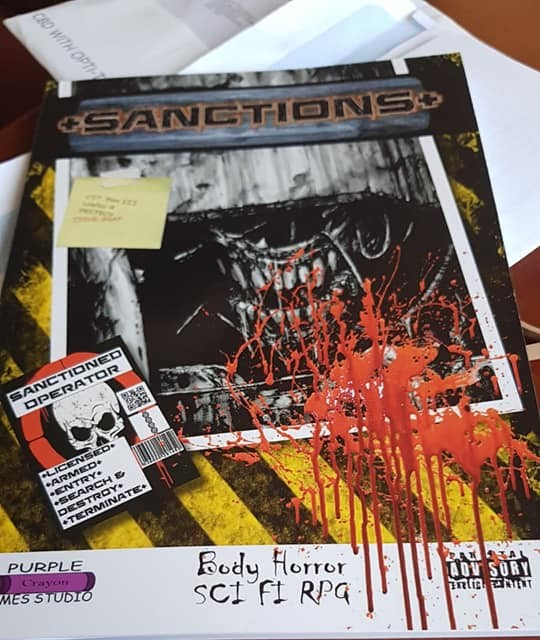
Red Room: I know about some of your sources of inspiration for Sanctions – such as David Cronenberg -, but do tell us some more about what fuelled your creativity while developing the game.
Liam Thompson: As you know Sanctions has been, in one version or another, for a huge amount of time and has, in part, grown and mutated into its current setting, much like the monsters and world itself. Initially the inspiration was an idea for a setting that was near future secret agents for hire, James Bond meets Ronin.
“Sanctions has been, in one version or another, for a huge amount of time and has, in part, grown and mutated into its current setting, much like the monsters and world itself.”
Literary and media influences include: Mary Shelley’s Frankenstein, Shinya Tsukamoto’s Tetsuo, George Romero, John Wyndham, William Burroughs, William Gibson, Serpieri’s Druuna, John Carpenter, Judge Dredd, SLA Industries, Blade Runner, Phillip K. Dick and Hunter S. Thompson. The list goes on…
One of the major inspirations was my first forays into work, when I went to work at a temporary agency who insisted that I buy my own boots and high vis jacket. I had this idea where private security investigators worked for a company, but had to buy their own equipment. It was the 80’s, the Cold War and nuclear fear was everywhere, strikes, poll tax, riots, good music, sex, drugs and rock and roll.
Red Room: It is labelled as a body horror role-playing game. How do you describe the genre and for whom is this kind of game intended?
Liam Thompson: Body horror simply is horror involving the body, genetic mutation, invasion, mutilation, evolution, parasitic infestation and worse. Great examples are The Thing, The Fly, the Alien movies and all the other greats. Ultimately, though, the enemy in all these settings are the people. As I say in Sanctions: “Ultimately the worst things I’ve seen are done by us. Humans are by far the biggest monsters in the world.”
These kinds of games and settings are not for the squeamish, easily offended and certainly not those who want to feel “safe”. What’s that all about anyway? Hell’s tits, if you watch Moomins the Hatty Fattners were terrifying!

Red Room: Sanctions trades the usual cyberpunk enhancements for biotech augments. It does make sense for a body horror game, but was that the only reason you opted for it? Do you think cyberpunk as a genre is out-dated by now?
No, actually my late father, credited in the book, helped with Sanctions going towards the body horror bio-technology route. The setting originally used cybertech and I was chatting to my father – Peter Thompson, who by the way, hated most sci-fi – sat there and said from behind his paper: “Never work son, people won’t want that stuff in them unless they had to.” It was also the days of the infancy of biotech commercially, glowing mice, mice with ears on the back, DNA fingerprinting. Also Sea Monkeys (genetically modified pets).
Do I think cyberpunk has had its day? No, I love it. My main issue has, and always been, the glitzy neon of it all. To me the essence of cyberpunk has been Max Headroom’s gloomy dirty edgy environment and the human element. Sanctions is still at its heart very punk with its references to older electronic music and movies, a kind of retro, alternative future.

Red Room: I know there’s at least one sourcebook coming for Sanctions. What is it about and when should we expect it to be released?
Liam Thompson: Yes indeed. The first of a series, possibly called Ops & Admin. It’s a player’s guide and world expansion, as ideas keep coming, and also a GM expansion giving extra notes. It will be in the style of a cross between an industry magazine and company handbook. It will be out soon, I promise. I’m just waiting on a couple of pieces of art and final layout.
Red Room: Are you planning or working on further supplements for the line?
Liam Thompson: There will be further Ops books, at least, as well as a published adventure co-written with my great friend Simon Jackson, a fellow games writer in Northampton who is developing a future sports board game as we speak.
Red Room: Tell us a bit about the game rules-wise. Do you favour rules-light games or you prefer more detailed mechanics?
Liam Thompson: Oh, simple is better, to me the idea is about the story and fast paced resolution over tables, maths and mechanics. Core=6 is a simple dice pool system using D6: 5 and 6 are successes, versus a task level table dictating how many successes are required. Essentially: Stat + Skill + (or minus) modifiers equal the dice rolled.
I had tried to create several systems over the years but discovered that I had recreated existing rules, one iteration was AFF, a couple of others were versions of T&T, there was a percentile one (I hated). It was funny when I play tested these and players would say “oh! I get it, it’s like Fighting Fantasy or Troika or whatever”… I would sit there and scream!
“The first of a series, possibly called Ops & Admins. It’s a players guide and world expansion (…). It will be out soon”
Red Room: When did Purple Crayon Games start and was Sanctions your first release?
Liam Thompson: Purple Crayon Games (PCG) started as an entity approximately five or six years ago, when I was encouraged by friends who had seen and played some of my unpublished works who all cajoled me into releasing them.
There were quite a few games written by myself and friends as teenagers, lost in the mists of time, either hand written, or using manual typewriters and photocopied at school. My first PCG games released into the wild were small minimal games in a pocketmod format. Pocketmods are a way of printing 8 pages on one sheet of A4, folding it a certain way and it’s like a mini book. Of these there were several, Aspects, a general minimalist genre-less game, which later became the Core6 system I finalised for PCG, Blood and Steel, and several others.
After a friend advised I should try to publish, and I was feverishly collating reference materials and researching, my 11 year old granddaughter, who had played a homebrew RPG with me before, said she had an idea, it was a fantasy game. But I wanted to help her become a bit more creative. It was called Tribes of Krass and was heavily Conan and Ralph Bakshi’s Fire & Ice inspired primeval fantasy. We released it via Itch.io and sold a few copies. Ken St. Andre bought a copy and sent glowing reports back to my granddaughter; made me cry.
Sanctions has been a lifelong project in many forms for the best part of 30 plus years and has only come together in its present released format in the last year.

Red Room: As far as I know Purple Crayon Games doesn’t have a website, but correct me if I am wrong. If so, are you planning on setting up a website eventually?
Liam Thompson: Oh, please, please, please find me someone who can make me a page, I am useless at this sort of thing. I dearly want a page and, for all my love of computers, tech and science I cannot get my head round making a web page. If anyone wants to volunteer then please help!
Red Room: Was there a Kickstarter campaign for Sanctions?
Liam Thompson: No, no, there wasn’t for a couple of reasons: I have seen and backed a few Kickstarters that failed, and my mind-set hates knock backs, so if I failed in my KS campaign I’d probably have given up. I actually dislike the concept of the entire goals and stretch goals, promising further things if backers throw in more cash; it doesn’t seem right somehow… Before Kickstarters people just took a gamble and tried, I’m kind of stuck in the past that way. With Lulu and Drivethru it has become so accessible to be able to publish, then why not do it that way? I know that some folk have got great promotion and initial sales that way, but it’s not what I’m into.
Red Room: How have you been promoting your game?
Liam Thompson: Terribly, I am awful at self-promotion. I can come across as outspoken and brash, but I’m actually very timid when it comes to saying: “Hey buy my games, they’re awesome”. I like to promote others’ indie work and hope that they will reciprocate.
Red Room: I think you did most of the work for the core book, except for the art. Is this correct?
Liam Thompson: Mostly, the writing, layout and main setting is all me, but I did have a lot of help from some great friends and collaborators like Peter Wallis, who gave input with the adventure creation tool, Charlie Warren and Joe Coombs. A great local artist called Martyn Lorbieki did some character art for free, which really was awesome.

Red Room: Now, tell us a bit about yourself.
Liam Thompson: I’m a human being from the UK, I’ve spent a couple of years living overseas, but I currently live and work in Northampton.
Red Room: How did you find out about tabletop role-playing games and when did you start actively playing and game mastering?
Liam Thompson: I discovered TTRPG’s way back in the early 80’s, I had already read The Hobbit, and since I was tiny loved sci-fi and fantasy. The Fighting Fantasy books had been released and I was getting into them. When on holiday my father took me to a book shop and we found the Corgi edition of Tunnels & Trolls, and he bought me around four or five of the books, both the core book and the solo adventures. I loved them, but the core book baffled me.
When I got home, and back to school, my friends and I managed to work it out during lunch times. We had a great English teacher, Mrs. Harris, who had a chess club at lunchtimes, but encouraged us creative types to explore things. We got the hang of it and started to play. We then discovered other games like Fighting Fantasy, and Dragon Warriors, before we found out about the dreaded big books and boxes. We started quite quickly to homebrew our own systems, that would allow us to create and play quickly during our limited times at school. But we always went back to our small novel sized games.
Red Room: Which are your favourite genres, either in role-playing games and fiction in general?
Liam Thompson : Hmm. Tricky I am very eclectic in fiction I can cover all bases, with an addiction for ‘80s action and modern B movies (unashamedly), but I do have a passion for the edgier, thought provoking, storylines. With RPGs I am in a similar persuasion but I try to avoid any games that are tiresome. Fantasy for instance, how many times can you try to make an Elf different?
Red Room: Which RPGs have influenced you the most?
Liam Thompson: Easily the three above, Tunnels & Trolls by the “Trollgod” Ken St Andre, Dragon Warriors and the Fighting Fantasy RPG, their simplicity is exquisite.
YOU CAN PURCHASE SANCTIONS AT LULU.COM

Red Room: The introduction tells us about a game that’s half science-fiction, half fantasy, but the second half seems to be especially low-tech and post-apocalyptical, still more sci-fi than fantasy. Am I wrong?
Brian Shutter: Nope, you are right. The fantasy aspect is a low fantasy world and mostly covers the classic DnD monsters and magic.
Red Room: The Neon Lords core book is filled to the brim with references to the 1980s and 1990s, it’s fuelled by GenX nostalgia. Have you play-tested it with younger players or had any reactions from them? Can they even relate to this setting?
Brian Shutter: Yes, our playtest group has some players close to 21 years in it and, while they may have not gotten most references, they had fun playing.
Red Room: There have been several games exploring this nostalgia, but they approach the theme in a different way, putting the players into the role of what they were at the time – children and pre-teens in awe – and not the reason behind that fascination. Here it’s all about the heroes of our childhood. Have you any interest in The Goonies-style games too?
Brian Shutter: I wouldn’t mind playing one and seeing the other end of the spectrum.
Red Room: There’s plenty of green slime around that wasteland. I suppose while doing your research you found that 1980s science-fiction and horror are full of greenish goo?
Brian Shutter: Not only that, but the children’s channel Nickelodeon. That had slime coming out of their ears in the ‘80s ‘90s.

Red Room: I rather liked the art. Is it supposed to emulate ZX Spectrum games’ looks or it’s just a similar colour palette?
Brian Shutter: It’s intended. I have a fondness for the ZX Spectrum, despite being American.
“I have a fondness for the ZX Spectrum, despite being American.”
Red Room: The Neon Lords is definitely an OSR game?
Brian Shutter: Yes. It’s based off of the BX rules and built from there.
Red Room: The neon wastelands are supposed to be as deadly as the usual OSR game setting? I mean, should players expect to roll up a lot of characters while playing?
Brian Shutter: Yes! The game is deadly, that’s why we gave the classes a lot of rad abilities off the bat to have some over the top fun before being brutally slaughtered!
Red Room: What would be the stereotypical party for a game of Neon Lords?
Brian Shutter: It would be safe to assume the standard DnD party dynamic. Having someone good at fighting, with high HP, a healer, magic user, thief, and some random class would be smart. But, with that being said, I think any array of classes could do just fine.
Red Room: This is a huge book. I’m used to OSR games being smaller…
Brian Shutter: Yeah, its rules plus setting and two adventures.
Red Room: Which were your major influences when writing the setting?
Brian Shutter: Lots of heavy metal, ‘80s and ‘90s video games and movies, the 90s “in your face” marketing, Saturday morning cartoons and the prizes you get in cereal, the idea of enticing children to eat a product with a small plastic toy buried deep within.

Red Room: Would you care to name same of those metal bands and video games that influenced you?
Brian Shutter: Yeah of course! Bolt Thrower, Cannibal Corpse, Tomb Mold, Carcass, Napalm Death, Amon Amarth, Toxic Holocaust, Municipal Waste, Mastodon, Perturbator, Pig Destroyer. And the games: Battle Toads, Contra, Castlevania, Violent Storm, Altered Beast, Captain Commando, Mega Man, Streets of Rage, Doom, Duke Nuke ‘Em, Mortal Kombat, Gauntlet, Magic Sword, Rastan, Golden Axe, Quake…
Red Room: Did you feel restrained by the source material being ultra-violent, yet based in movies and animated series where the brutality itself is very cartoonish and tame?
Brian Shutter: I don’t feel restrained. We just take the stuff that influenced us and crank it to 10.
Red Room: You did the layout, but none of the art, right?
Brian Shutter: Yes, all the art is by other people. Each of them did a fantastic job bringing my words to life.
Red Room: Please, tell me a bit more about the setting. I would like you to point out what you find most interesting about it.
Brian Shutter: The most interesting thing to me is the world we know it was destroyed in the Neon Wars of 1992. Chaos ensued for millions of years that finally ended with the Gnarly Age, a time that harkens back to the 1980s and 1990s. Where they worship Gods such as Lord Randy, the savage one, and adopt styles and slang of the time.
“(…) they worship Gods such as Lord Randy, the savage one, and adopt styles and slang of the time”
Red Room: Lord Randy is Randy Savage, the wrestler?
Brian Shutter: Yes. The pantheon of gods consists of a bunch of wrestlers.
Red Room: Wrestling was bigger in the United States at the time, wasn’t it?
Brian Shutter: Yeah, I would say it was at its peak with Hulk Hogan and the Macho Man in the late 80s early 90s.
Red Room: The setting lives exclusively on American themes or did you have European influences too?
Brian Shutter: A lot of Games Workshop’s early games including Warhammer 40K, and 2000AD comics, mostly Judge Dredd, but also ABC Warriors, Nemesis the Warlock, and Strontium Dog are all in there too.

Red Room: For how long did you work on it?
Brian Shutter: Two years it took.
Red Room: You did all of the writing?
Brian Shutter: Yes, but I had some input by friends, and some editing help.
Red Room: Did the success of Mork Borg have anything to do with your decision to write the game, or the metal connection comes from other places?
Brian Shutter: I was doing all this before the Mork Borg revolution. Mork Borg is very doom metal influenced we strive to be more of a thrash 80s hair metal vibe.
Red Room: Do you think said Mork Borg revolution was good for launching your own game?
Brian Shutter: Good question. It’s hard to tell because we are such a small game, but we have some of the most rabid fans.
“I was doing all this before the Mork Borg Revolution. Mork Borg is very doom metal influenced, we strive to be more of a thrash 80s hair metal vibe.“
Red Room: How did the Kickstarter go? How much were you aiming for?
Brian Shutter: We aimed to get enough backers to get a book made and we funded in three days and hit 11k.
Red Room: That sounds good, but I am not a Kickstarter specialist…
Brian Shutter: Neither am I, but I feel we did very well. Especially since we have no other products out there.
Red Room: Are you planning on further sourcebooks or scenarios?
Brian Shutter: Yes, there is a list of books coming out: Hack and Thrash is a vehicle rule supplement with skateboards, BMX bikes, and Mad Max style cars and trucks, as well as some stats for your favourite vehicles from other media. Deities and Demi-Bros is a supplement stating and describing all the gods that can be worshipped in the Neon Wastelands, as well as various adventure modules. And Escape the Murder Maze, a death match miniatures game for 1-10 players, is also in development. It takes place in the Neon Lords universe.
Red Room: That’s quite a lot! I suppose most of that is still in the works?
Brian Shutter: Yes since the core rules is done I have time to crank out the other stuff. But it will be awhile before the next book is released.
Red Room: How have you been promoting the game?
Brian Shutter: I’ve been trying to promote on Facebook and Instagram, but I’m honestly not very good at it. It’s not easy; there are so many games out there. It’s hard to put yourself in front of all of the other great games.
Red Room: Do you have a website for Neon Lords?
Brian Shutter: I think eventually we will, but I don’t know much about website design.
Red Room: Will there be a print-on-demand version of the game on Drivethru?
Brian Shutter: The POD option will come eventually!

Red Room: Before we finish tell us a bit about yourself…
Brian Shutter: I’m 39 and I am from – and currently live in – upstate New York.
Red Room: When did you start role-playing and how did you discover the hobby?
Brian Shutter: I started on the board game Hero Quest and from there to an Advanced Dungeons & Dragons starter kit.
Red Room: And when was that?
Brian Shutter: 1989.
Red Room: You kept playing D&D since then or you moved along to other games?
Brian Shutter: I played up to 2nd edition and stopped for a bit, got back into 3rd for a while, then tried 4th and didn’t like it. So I stopped until 5th edition and everyone wanted to play DnD. So I played a lot of 5th edition. While playing DnD I’ve always had other games on the side and incorporated other game mechanics into my homebrews.
Red Room: Did you write any other games before Neon Lords?
Brian Shutter: I have not. Neon Lords is my first game.
Red Room: Was there some reason why you waited that long?
Brian Shutter: I never had anything I really wanted to publish, honestly. Until we started this gonzo post-apocalyptic, neon ooze of a game.
WHILE YOU WAIT FOR THE FULL RELEASE, YOU CAN CHECK OUT THE QUICKSTART AND A COUPLE OF SCENARIOS ON DRIVETHRU


