Postcards from Avalidad is a darkly surreal horror meets Tech-Noir game setting and adventure context for Punk (included) and Actual Fcking Monsters.
Avalidad combines cyber, bio and psi punk to create a Burroughsian nightmare world of decadence, drugs, Libertarianism, violence, glamour and oppression.
You will delve into the strange lives of Avalidad’s celebrities, fiscal royalty and seedy underbelly in this unique game setting.
This is the my fifth scenario published by James ‘Grim’ Desborough’s Postmortem Studios, after the Postmortem Giallo trilogy (Orpheum Lofts, The Memorial and The Sisters of the Seven Sins) and Welcome to St. Cloud.
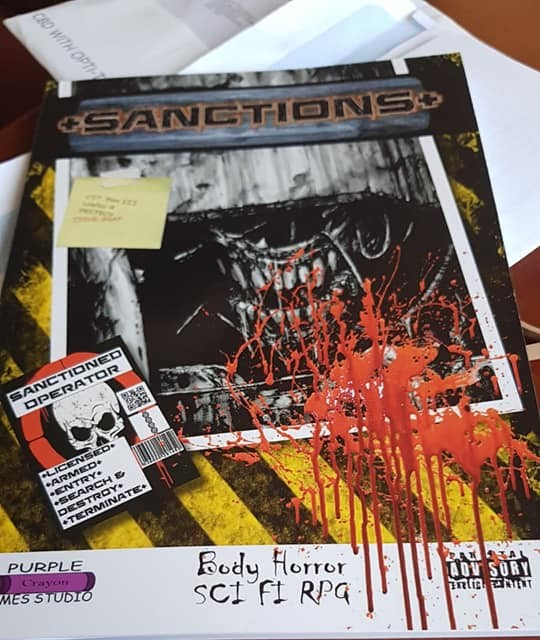
SANCTIONS: The first sourcebook for this body horror role-playing set in a dystopic future, where people live in a world troubled by climate change, toxic pollution and horrifying mutated creatures, will be out soon. We had a chat with the author about the genesis and future of the game.
Sanctions takes place in 2086, biotechnology has grown at a rapid pace, war erupted and chemical, biological and use of nuclear weapons polluted most of Europe and Russia. Climate change occurred and mutated beings, both natural and lab grown, roam the countryside. To protect the cities, vast walls were erected and the urban centres merge into Plexes. Behind the facade of society, horrific crimes take place, murders, illegal experiments and worse. Laws allow for staffing agencies to become “sanctioned”, and armed operatives do the work no one else wants to. Sanction agents perform everything from policing, search and rescue, to espionage work.
Red Room: I know about some of your sources of inspiration for Sanctions – such as David Cronenberg -, but do tell us some more about what fuelled your creativity while developing the game.
Liam Thompson: As you know Sanctions has been, in one version or another, for a huge amount of time and has, in part, grown and mutated into its current setting, much like the monsters and world itself. Initially the inspiration was an idea for a setting that was near future secret agents for hire, James Bond meets Ronin.
“Sanctions has been, in one version or another, for a huge amount of time and has, in part, grown and mutated into its current setting, much like the monsters and world itself.”
Literary and media influences include: Mary Shelley’s Frankenstein, Shinya Tsukamoto’s Tetsuo, George Romero, John Wyndham, William Burroughs, William Gibson, Serpieri’s Druuna, John Carpenter, Judge Dredd, SLA Industries, Blade Runner, Phillip K. Dick and Hunter S. Thompson. The list goes on…
One of the major inspirations was my first forays into work, when I went to work at a temporary agency who insisted that I buy my own boots and high vis jacket. I had this idea where private security investigators worked for a company, but had to buy their own equipment. It was the 80’s, the Cold War and nuclear fear was everywhere, strikes, poll tax, riots, good music, sex, drugs and rock and roll.
Red Room: It is labelled as a body horror role-playing game. How do you describe the genre and for whom is this kind of game intended?
Liam Thompson: Body horror simply is horror involving the body, genetic mutation, invasion, mutilation, evolution, parasitic infestation and worse. Great examples are The Thing, The Fly, the Alien movies and all the other greats. Ultimately, though, the enemy in all these settings are the people. As I say in Sanctions: “Ultimately the worst things I’ve seen are done by us. Humans are by far the biggest monsters in the world.”
These kinds of games and settings are not for the squeamish, easily offended and certainly not those who want to feel “safe”. What’s that all about anyway? Hell’s tits, if you watch Moomins the Hatty Fattners were terrifying!
Red Room: Sanctions trades the usual cyberpunk enhancements for biotech augments. It does make sense for a body horror game, but was that the only reason you opted for it? Do you think cyberpunk as a genre is out-dated by now?
No, actually my late father, credited in the book, helped with Sanctions going towards the body horror bio-technology route. The setting originally used cybertech and I was chatting to my father – Peter Thompson, who by the way, hated most sci-fi – sat there and said from behind his paper: “Never work son, people won’t want that stuff in them unless they had to.” It was also the days of the infancy of biotech commercially, glowing mice, mice with ears on the back, DNA fingerprinting. Also Sea Monkeys (genetically modified pets).
Do I think cyberpunk has had its day? No, I love it. My main issue has, and always been, the glitzy neon of it all. To me the essence of cyberpunk has been Max Headroom’s gloomy dirty edgy environment and the human element. Sanctions is still at its heart very punk with its references to older electronic music and movies, a kind of retro, alternative future.
Red Room: I know there’s at least one sourcebook coming for Sanctions. What is it about and when should we expect it to be released?
Liam Thompson: Yes indeed. The first of a series, possibly called Ops & Admin. It’s a player’s guide and world expansion, as ideas keep coming, and also a GM expansion giving extra notes. It will be in the style of a cross between an industry magazine and company handbook. It will be out soon, I promise. I’m just waiting on a couple of pieces of art and final layout.
Red Room: Are you planning or working on further supplements for the line?
Liam Thompson: There will be further Ops books, at least, as well as a published adventure co-written with my great friend Simon Jackson, a fellow games writer in Northampton who is developing a future sports board game as we speak.
Red Room: Tell us a bit about the game rules-wise. Do you favour rules-light games or you prefer more detailed mechanics?
Liam Thompson: Oh, simple is better, to me the idea is about the story and fast paced resolution over tables, maths and mechanics. Core=6 is a simple dice pool system using D6: 5 and 6 are successes, versus a task level table dictating how many successes are required. Essentially: Stat + Skill + (or minus) modifiers equal the dice rolled.
I had tried to create several systems over the years but discovered that I had recreated existing rules, one iteration was AFF, a couple of others were versions of T&T, there was a percentile one (I hated). It was funny when I play tested these and players would say “oh! I get it, it’s like Fighting Fantasy or Troika or whatever”… I would sit there and scream!
“The first of a series, possibly called Ops & Admins. It’s a players guide and world expansion (…). It will be out soon”
Red Room: When did Purple Crayon Games start and was Sanctions your first release?
Liam Thompson: Purple Crayon Games (PCG) started as an entity approximately five or six years ago, when I was encouraged by friends who had seen and played some of my unpublished works who all cajoled me into releasing them.
There were quite a few games written by myself and friends as teenagers, lost in the mists of time, either hand written, or using manual typewriters and photocopied at school. My first PCG games released into the wild were small minimal games in a pocketmod format. Pocketmods are a way of printing 8 pages on one sheet of A4, folding it a certain way and it’s like a mini book. Of these there were several, Aspects, a general minimalist genre-less game, which later became the Core6 system I finalised for PCG, Blood and Steel, and several others.
After a friend advised I should try to publish, and I was feverishly collating reference materials and researching, my 11 year old granddaughter, who had played a homebrew RPG with me before, said she had an idea, it was a fantasy game. But I wanted to help her become a bit more creative. It was called Tribes of Krass and was heavily Conan and Ralph Bakshi’s Fire & Ice inspired primeval fantasy. We released it via Itch.io and sold a few copies. Ken St. Andre bought a copy and sent glowing reports back to my granddaughter; made me cry.
Sanctions has been a lifelong project in many forms for the best part of 30 plus years and has only come together in its present released format in the last year.
Red Room: As far as I know Purple Crayon Games doesn’t have a website, but correct me if I am wrong. If so, are you planning on setting up a website eventually?
Liam Thompson: Oh, please, please, please find me someone who can make me a page, I am useless at this sort of thing. I dearly want a page and, for all my love of computers, tech and science I cannot get my head round making a web page. If anyone wants to volunteer then please help!
Red Room: Was there a Kickstarter campaign for Sanctions?
Liam Thompson: No, no, there wasn’t for a couple of reasons: I have seen and backed a few Kickstarters that failed, and my mind-set hates knock backs, so if I failed in my KS campaign I’d probably have given up. I actually dislike the concept of the entire goals and stretch goals, promising further things if backers throw in more cash; it doesn’t seem right somehow… Before Kickstarters people just took a gamble and tried, I’m kind of stuck in the past that way. With Lulu and Drivethru it has become so accessible to be able to publish, then why not do it that way? I know that some folk have got great promotion and initial sales that way, but it’s not what I’m into.
Red Room: How have you been promoting your game?
Liam Thompson: Terribly, I am awful at self-promotion. I can come across as outspoken and brash, but I’m actually very timid when it comes to saying: “Hey buy my games, they’re awesome”. I like to promote others’ indie work and hope that they will reciprocate.
Red Room: I think you did most of the work for the core book, except for the art. Is this correct?
Liam Thompson: Mostly, the writing, layout and main setting is all me, but I did have a lot of help from some great friends and collaborators like Peter Wallis, who gave input with the adventure creation tool, Charlie Warren and Joe Coombs. A great local artist called Martyn Lorbieki did some character art for free, which really was awesome.
Red Room: Now, tell us a bit about yourself.
Liam Thompson: I’m a human being from the UK, I’ve spent a couple of years living overseas, but I currently live and work in Northampton.
Red Room: How did you find out about tabletop role-playing games and when did you start actively playing and game mastering?
Liam Thompson: I discovered TTRPG’s way back in the early 80’s, I had already read The Hobbit, and since I was tiny loved sci-fi and fantasy. The Fighting Fantasy books had been released and I was getting into them. When on holiday my father took me to a book shop and we found the Corgi edition of Tunnels & Trolls, and he bought me around four or five of the books, both the core book and the solo adventures. I loved them, but the core book baffled me.
When I got home, and back to school, my friends and I managed to work it out during lunch times. We had a great English teacher, Mrs. Harris, who had a chess club at lunchtimes, but encouraged us creative types to explore things. We got the hang of it and started to play. We then discovered other games like Fighting Fantasy, and Dragon Warriors, before we found out about the dreaded big books and boxes. We started quite quickly to homebrew our own systems, that would allow us to create and play quickly during our limited times at school. But we always went back to our small novel sized games.
Red Room: Which are your favourite genres, either in role-playing games and fiction in general?
Liam Thompson : Hmm. Tricky I am very eclectic in fiction I can cover all bases, with an addiction for ‘80s action and modern B movies (unashamedly), but I do have a passion for the edgier, thought provoking, storylines. With RPGs I am in a similar persuasion but I try to avoid any games that are tiresome. Fantasy for instance, how many times can you try to make an Elf different?
Red Room: Which RPGs have influenced you the most?
Liam Thompson: Easily the three above, Tunnels & Trolls by the “Trollgod” Ken St Andre, Dragon Warriors and the Fighting Fantasy RPG, their simplicity is exquisite.
NEON LORDS OF THE TOXIC WASTELAND: Less than a year after the Kickstarter campaign which financed the project it is about to be launched in digital and printed format, scheduled for the end of next month. We talked to the author about this Generation X nostalgia fuelled OSR role-playing game, built upon BX rules.
Half gonzo science-fiction, half fantasy, Neon Lords of the Toxic Wasteland is set in a post-apocalyptic Earth in which magic is mixed with “ancient” technology from the ’80s and ’90s. The genre is cassette futurism, so expect to see a lot of crazy hairstyles: it’s not only the tech that harkens back to the glorious days of VHS tapes and glam metal, the whole game oozes nostalgia from the era. Ultra-violent, deadly and rather stylish – at least if you are into mullets and sexy cyborgs – describes the way of life in the toxic wastelands.
Red Room: The introduction tells us about a game that’s half science-fiction, half fantasy, but the second half seems to be especially low-tech and post-apocalyptical, still more sci-fi than fantasy. Am I wrong?
Brian Shutter: Nope, you are right. The fantasy aspect is a low fantasy world and mostly covers the classic DnD monsters and magic.
Red Room: The Neon Lords core book is filled to the brim with references to the 1980s and 1990s, it’s fuelled by GenX nostalgia. Have you play-tested it with younger players or had any reactions from them? Can they even relate to this setting?
Brian Shutter: Yes, our playtest group has some players close to 21 years in it and, while they may have not gotten most references, they had fun playing.
Red Room: There have been several games exploring this nostalgia, but they approach the theme in a different way, putting the players into the role of what they were at the time – children and pre-teens in awe – and not the reason behind that fascination. Here it’s all about the heroes of our childhood. Have you any interest in The Goonies-style games too?
Brian Shutter: I wouldn’t mind playing one and seeing the other end of the spectrum.
Red Room: There’s plenty of green slime around that wasteland. I suppose while doing your research you found that 1980s science-fiction and horror are full of greenish goo?
Brian Shutter: Not only that, but the children’s channel Nickelodeon. That had slime coming out of their ears in the ‘80s ‘90s.
Red Room: I rather liked the art. Is it supposed to emulate ZX Spectrum games’ looks or it’s just a similar colour palette?
Brian Shutter: It’s intended. I have a fondness for the ZX Spectrum, despite being American.
“I have a fondness for the ZX Spectrum, despite being American.”
Red Room: The Neon Lords is definitely an OSR game?
Brian Shutter: Yes. It’s based off of the BX rules and built from there.
Red Room: The neon wastelands are supposed to be as deadly as the usual OSR game setting? I mean, should players expect to roll up a lot of characters while playing?
Brian Shutter: Yes! The game is deadly, that’s why we gave the classes a lot of rad abilities off the bat to have some over the top fun before being brutally slaughtered!
Red Room: What would be the stereotypical party for a game of Neon Lords?
Brian Shutter: It would be safe to assume the standard DnD party dynamic. Having someone good at fighting, with high HP, a healer, magic user, thief, and some random class would be smart. But, with that being said, I think any array of classes could do just fine.
Red Room: This is a huge book. I’m used to OSR games being smaller…
Brian Shutter: Yeah, its rules plus setting and two adventures.
Red Room: Which were your major influences when writing the setting?
Brian Shutter: Lots of heavy metal, ‘80s and ‘90s video games and movies, the 90s “in your face” marketing, Saturday morning cartoons and the prizes you get in cereal, the idea of enticing children to eat a product with a small plastic toy buried deep within.
Red Room: Would you care to name same of those metal bands and video games that influenced you?
Brian Shutter: Yeah of course! Bolt Thrower, Cannibal Corpse, Tomb Mold, Carcass, Napalm Death, Amon Amarth, Toxic Holocaust, Municipal Waste, Mastodon, Perturbator, Pig Destroyer. And the games: Battle Toads, Contra, Castlevania, Violent Storm, Altered Beast, Captain Commando, Mega Man, Streets of Rage, Doom, Duke Nuke ‘Em, Mortal Kombat, Gauntlet, Magic Sword, Rastan, Golden Axe, Quake…
Red Room: Did you feel restrained by the source material being ultra-violent, yet based in movies and animated series where the brutality itself is very cartoonish and tame?
Brian Shutter: I don’t feel restrained. We just take the stuff that influenced us and crank it to 10.
Red Room: You did the layout, but none of the art, right?
Brian Shutter: Yes, all the art is by other people. Each of them did a fantastic job bringing my words to life.
Red Room: Please, tell me a bit more about the setting. I would like you to point out what you find most interesting about it.
Brian Shutter: The most interesting thing to me is the world we know it was destroyed in the Neon Wars of 1992. Chaos ensued for millions of years that finally ended with the Gnarly Age, a time that harkens back to the 1980s and 1990s. Where they worship Gods such as Lord Randy, the savage one, and adopt styles and slang of the time.
“(…) they worship Gods such as Lord Randy, the savage one, and adopt styles and slang of the time”
Red Room: Lord Randy is Randy Savage, the wrestler?
Brian Shutter: Yes. The pantheon of gods consists of a bunch of wrestlers.
Red Room: Wrestling was bigger in the United States at the time, wasn’t it?
Brian Shutter: Yeah, I would say it was at its peak with Hulk Hogan and the Macho Man in the late 80s early 90s.
Red Room: The setting lives exclusively on American themes or did you have European influences too?
Brian Shutter: A lot of Games Workshop’s early games including Warhammer 40K, and 2000AD comics, mostly Judge Dredd, but also ABC Warriors, Nemesis the Warlock, and Strontium Dog are all in there too.
Red Room: For how long did you work on it?
Brian Shutter: Two years it took.
Red Room: You did all of the writing?
Brian Shutter: Yes, but I had some input by friends, and some editing help.
Red Room: Did the success of Mork Borg have anything to do with your decision to write the game, or the metal connection comes from other places?
Brian Shutter: I was doing all this before the Mork Borg revolution. Mork Borg is very doom metal influenced we strive to be more of a thrash 80s hair metal vibe.
Red Room: Do you think said Mork Borg revolution was good for launching your own game?
Brian Shutter: Good question. It’s hard to tell because we are such a small game, but we have some of the most rabid fans.
“I was doing all this before the Mork Borg Revolution. Mork Borg is very doom metal influenced, we strive to be more of a thrash 80s hair metal vibe.“
Red Room: How did the Kickstarter go? How much were you aiming for?
Brian Shutter: We aimed to get enough backers to get a book made and we funded in three days and hit 11k.
Red Room: That sounds good, but I am not a Kickstarter specialist…
Brian Shutter: Neither am I, but I feel we did very well. Especially since we have no other products out there.
Red Room: Are you planning on further sourcebooks or scenarios?
Brian Shutter: Yes, there is a list of books coming out: Hack and Thrash is a vehicle rule supplement with skateboards, BMX bikes, and Mad Max style cars and trucks, as well as some stats for your favourite vehicles from other media. Deities and Demi-Bros is a supplement stating and describing all the gods that can be worshipped in the Neon Wastelands, as well as various adventure modules. And Escape the Murder Maze, a death match miniatures game for 1-10 players, is also in development. It takes place in the Neon Lords universe.
Red Room: That’s quite a lot! I suppose most of that is still in the works?
Brian Shutter: Yes since the core rules is done I have time to crank out the other stuff. But it will be awhile before the next book is released.
Red Room: How have you been promoting the game?
Brian Shutter: I’ve been trying to promote on Facebook and Instagram, but I’m honestly not very good at it. It’s not easy; there are so many games out there. It’s hard to put yourself in front of all of the other great games.
Red Room: Do you have a website for Neon Lords?
Brian Shutter: I think eventually we will, but I don’t know much about website design.
Red Room: Will there be a print-on-demand version of the game on Drivethru?
Brian Shutter: The POD option will come eventually!
Red Room: Before we finish tell us a bit about yourself…
Brian Shutter: I’m 39 and I am from – and currently live in – upstate New York.
Red Room: When did you start role-playing and how did you discover the hobby?
Brian Shutter: I started on the board game Hero Quest and from there to an Advanced Dungeons & Dragons starter kit.
Red Room: And when was that?
Brian Shutter: 1989.
Red Room: You kept playing D&D since then or you moved along to other games?
Brian Shutter: I played up to 2nd edition and stopped for a bit, got back into 3rd for a while, then tried 4th and didn’t like it. So I stopped until 5th edition and everyone wanted to play DnD. So I played a lot of 5th edition. While playing DnD I’ve always had other games on the side and incorporated other game mechanics into my homebrews.
Red Room: Did you write any other games before Neon Lords?
Brian Shutter: I have not. Neon Lords is my first game.
Red Room: Was there some reason why you waited that long?
Brian Shutter: I never had anything I really wanted to publish, honestly. Until we started this gonzo post-apocalyptic, neon ooze of a game.
WHILE YOU WAIT FOR THE FULL RELEASE, YOU CAN CHECK OUT THE QUICKSTART AND A COUPLE OF SCENARIOS ON DRIVETHRU
A systemless adventure context for modern, surreal horror in the Lynchian style. Presented with optional stats for use with Actual F*cking Monsters by Postmortem Studios.
A loving homage to Twin Peaks, David Lynch and other surreal modern fantasy/horror, St. Cloud gives you a bunch of people, with secrets, an unspeakable evil and a lot of options for a short campaign in a very strange place.
When, in late 1990, I started watching Twin Peaks for the first time, there was no way I could guess that, years after, it would become my main source of inspiration as a games master. At the time I was still playing Dungeons & Dragons, so there was little I could salvage from a bizarre soap opera with a touch of dark humour and subtle hints of the supernatural. Only when I picked up Kult, Vampire, and other more narratively inclined games, did David Lynch’s cult TV show have any effect on my role-playing game scenarios. But, even then, I wasn’t quite aware of it.
Nowadays, I obviously know most of my storylines are structured like twisted soap operas; those that were published through Postmortem Studios in particular. Having watched a lot of Brazilian “telenovelas” – the South-American version of soap operas – during childhood and early teenage years certainly played a part in that as well. But, quite frankly, I never enjoyed them, and I still don’t. Anyway, even those aren’t as shallow as they seem: there are Shakespearean, Greek mythology and magical realism references throughout most Brazilian TV productions of the genre.
Watching Lynch’s work introduced me to the ingredient that makes the typically “soapish” web of intrigue – the patchwork of love affairs, betrayal and bitter rivalry – much more interesting: surrealism. Yes, at first it still feels like bland and corny melodrama, but that should quickly fade away and give rise to something else, something strange: a mix of stereotyped, vapid characters and facile affairs which acquire a whole new level of complexity whenever there’s a dark undertone playing beneath it. Mulholland Dr. (2001), also by David Lynch, applied the same recipe, with arguably an even more glorious effect. After all that was film, not television…
Kyle MacLachlan as Special Agent Dale Cooper
Dark humour also helps turning that daytime drama story into an entirely different beast. In Twin Peaks there was a show-within-the show titled Invitation to Love, a very inane, clichéd serial, that some of the characters, among them Lucy Moran (Kimmy Robertson), Shelly Johnson (Mädchen Amick) and Leland Palmer (Ray Wise), were following with interest. The absurdly kitsch Invitation to Love was, partly, an inside joke about the series’ cannibalization of TV tropes. It also offered viewers a subtle and weird reflection on Twin Peaks’ unfolding narrative. Mark Frost himself, co-author of the cult TV series, called it “a cultural compost heap” at the time of its release.
Writing scenarios using such a recipe is certainly time-consuming. This isn’t your low-prep game session material; far from it. Developing a cast of characters with underlying tensions and interconnected secrets takes time and effort. It probably only pays-off to write something like that when you plan to run it as a mid-sized campaign, or as a setting you pick up regularly for one-shots. Or you can also buy it, already developed, obviously. The main advantage of this modus operandi (read this in Regional Bureau Chief Gordon Cole’s voice, please) is that the previous hard work has already laid the foundation for whatever comes next. You can even run it with several different groups without turning it into a repetitive chore. Just add some new player characters, all the rest is already at hand, but the drama is bound to unfold in different ways, with distinct groups of people.
While writing Welcome to St. Cloud the formula for surreal soap opera ambiance adapted to role-playing scenarios turned clearer to me. David Lynch’s Twin Peaks, which heavily influenced St. Cloud, was presented as a crime drama, and it does start like one, aside from a few strange events, like fish stuck in percolators and Special Agent Dale Cooper’s (Kyle MacLachlan) idiosyncrasies. However, it doesn’t take too long before the offbeat and nightmarish incidents start. It was at that moment a sizable chunk of the audience gave up on the series back in the ‘90s despite, at first, having been a hit. Welcome to St. Cloud is meant to have the same kind of dark undertone. In the beginning, the town is introduced as a wholesome and traditional North-American community, which has been almost oblivious to the outside world for decades. However, behind that flimsy façade of normalcy, there are quite a lot of untold tragic and sinister stories. Some of them are no more than dirty little secrets, but there are also hidden fetishes, betrayals, love affairs and even crimes, that will shatter the whole town if they are let out in the open. And they will be!
Even before you start introducing the inhabitant’s ghastly secrets, it is already clear that there’s something wrong about that community, as it happened with that world-famous fictional place in the state of Washington. St. Cloudians are unconsciously aware of an enigmatic evil manifestation in the woods east of town, but they try very hard to conceal it, not really from outsiders, but mostly from themselves. That vile presence can be either supernatural in nature or just a symbol for the local folks’ own wickedness over successive generations. No matter how many intricate theories Twin Peak’s fans come up with, I’ve always preferred the more mundane explanations. There’s probably nothing otherworldly about it, just regular human nastiness. Naturally, in Welcome to St. Cloud, being a role-playing setting for a modern horror game (Actual Fucking Monsters) it does help having the occult and the paranormal to fall back on.
Welcome to St. Cloud wasn’t my first experience in dealing with a weird nexus of relationships. The Memorial was – long before I translated it into English, and decided to introduce themes from Italian giallo and “video nasties” – mainly influenced by Lars Von Trier’s Riget (1994) which, in turn, had in Twin Peaks an explicit source of inspiration. The Danish filmmakers’ TV drama is probably as surreal as Lynch’s – even if less labyrinthine –, but also leans on a mesh of conflict, affairs and feuding amongst its characters. It was quite “soapish”, although not as obviously so as Lynch’s seminal show. As for Orpheum Lofts, the first in my trilogy of giallo scenarios, its influences are also rather transparent. Under the Italian thriller atmosphere there’s obviously a cast of flawed characters, torn apart by internal conflict, which would belong in any American soap opera. The Sisters of the Seven Sins doesn’t quite fit the same category, as it was set in Portugal in the 1970s. Although its mood does not conform at all to a daytime serial portrayal of events, that doesn’t change the fact that it was structured around several nucleus of characters within which rivalries and dalliances are inevitable.
In this post I’ve been emphasizing the melodramatic side of Twin Peak’s influence over my role-playing writing, but the surreal facet is equally relevant. Since I started running horror RPGs as a game master (or Keeper, or Storyteller, or any other appropriate fancy title) I often noticed that introducing bizarre events and quirky or totally unhinged characters eases the burden of improvisation around the table. It probably works almost as well within the bounds of other genres, but my experience has been mainly in horror; especially modern horror. A considerable number of role players are wired to rationalize the events in the fiction, no matter how outlandish they are.
Quirky characters are a trademark of Lynch’s work
Games like Call of Cthulhu (or just about any other iteration of Lovecraftian Mythos) have taught people to accept unusual happenings as clues to a mystery and, as soon as you introduce a hint of strangeness, they will most likely try to identify patterns and ascertain causes. As David Lynch wrote in his book Catching the Big Fish: Meditation, Consciousness, and Creativity (which I strongly recommend to anyone who wishes to introduce tones of bizarre in role playing): “Cinema is a lot like music. It can be very abstract, but people have a yearning to make intellectual sense of it, to put it right into words. And when they can’t do that, it feels frustrating. But they can come up with an explanation from within, if they just allow it.”
So, when a game master throws in something enigmatic, even if at the time there was no obscure meaning at all, it will probably acquire some new significance in the players’ inquisitive minds. That’s a trick I have often used over the years and that achieved excellent results when applied to my own group of players in both Welcome to St. Cloud and the giallo trilogy. If the player’s explanation can somehow fit the narrative, the best thing for a games master to do is to go along with it. There’s a very strong probability that the outcome will be very positive, story-wise. Again, in Mr Lynch’s words (writing about Mulholland Dr): “The Box and The Key. I don’t have a clue what those are.” How many theories have you heard about it?